Common Carp
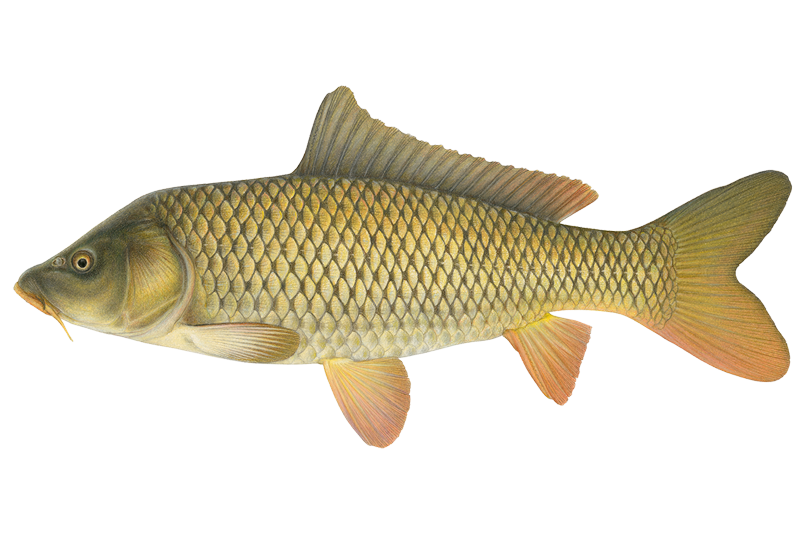
Common carp are not native to Brazil — they arrived as an introduced species and have established themselves across the country's southern and southeastern waters.
In São Paulo, Paraná, Santa Catarina, and Rio Grande do Sul, they're a genuine target for freshwater anglers, especially in reservoirs and slow urban rivers where native sport fish are scarce.
They grow large, root hard on the bottom, and test tackle in ways that keep dedicated carp anglers coming back.
Scientific Name: Cyprinus carpio
Also known as carpa, carpa-comum, carpa-europeia
- Body is deep and thick-set, covered in large, evenly spaced scales that run gold to dark olive-brown, with a pale cream or yellow belly.
- Two short barbels hang from each corner of the fleshy, downturned mouth — the clearest single ID feature separating carp from any native Brazilian cyprinid.
- Fins are reddish to orange-tinted; the long dorsal fin runs most of the back and has a serrated leading spine.
- Typical fish in Brazilian waters run 2–8 kg; fish pushing 15 kg or more are caught in productive reservoirs like Represa Billings.
What to know
Habitat Distribution
- Introduced, not native to Brazil; established populations are concentrated in the south and southeast — São Paulo, Paraná, Santa Catarina, and Rio Grande do Sul states.
- Thrives in slow-moving or still water: reservoirs, urban rivers, canals, and coastal lagoon systems in subtropical southern Brazil.
- Research has confirmed reproducing populations in subtropical coastal systems in southern Brazil, meaning the species is self-sustaining in those drainages.
- Also recorded in Mato Grosso do Sul (Rio Miranda drainage) and Rio de Janeiro waters, showing a broader footprint than just the deep south.
Key Locations
- Represa Billings, São Paulo — one of the most-cited carp spots in the country, a large reservoir with the structure and warm, productive water carp favor.
- Represa Guarapiranga, São Paulo — another major São Paulo reservoir with established carp populations and accessible shore fishing.
- Rio Tietê and Rio Sorocaba, São Paulo — slow urban rivers where carp have colonized silty stretches and canal sections.
- Canal de Santa Catarina, Santa Catarina — rated highly by local anglers; southern Brazil's canal systems hold good numbers of fish.
- Passauna Lake, Paraná — a productive reservoir in the Curitiba region with consistent carp catches reported.
Specific Spots
- Shallow, weedy margins of reservoirs — carp root through soft bottom sediment and decomposing vegetation looking for invertebrates, so these edges concentrate fish, especially in warmer months.
- Inflows and drainage channels where current carries food into still water; carp hold just off the main flow where they can intercept drifting material without fighting current.
- Silty bays and coves with submerged timber or concrete structure — urban reservoirs like Represa Billings and Represa Guarapiranga have plenty of both.
- Canal systems and slow urban rivers (Rio Tietê, Rio Sorocaba) where bottom debris accumulates; carp follow the food, not the scenery.
Common Carp FAQ
Answers from onWater's species guide.
What are the best lures and bait for Common Carp?
Boilies in corn, strawberry, or fishmeal flavors are the most consistent producers; fish them on a hair rig with a small PVA mesh bag of free offerings around the hook to draw fish in.
When is the best time to fish for Common Carp?
Spring and summer (September–February) bring the most active feeding as water temperatures rise; this is the prime window in São Paulo and Paraná. Autumn (March–May) can still produce well, especially in the warmer northern parts of the carp's Brazilian range, before water cools significantly.
How do you catch Common Carp?
Most Brazilian carp anglers fish from the bank or a fixed position on a reservoir margin, casting bottom rigs baited with boilies or corn to open water or near visible structure. Pre-baiting a chosen spot the day before significantly improves results.
What do Common Carp eat?
Carp are bottom-grubbers that eat aquatic invertebrates, worms, mollusks, algae, and decaying plant matter, match this with natural baits like earthworms, corn, or dough balls fished on or near the bottom.
Where do Common Carp live?
Introduced, not native to Brazil; established populations are concentrated in the south and southeast, São Paulo, Paraná, Santa Catarina, and Rio Grande do Sul states. Thrives in slow-moving or still water: reservoirs, urban rivers, canals, and coastal lagoon systems in subtropical southern Brazil.
See it in the app
Most maps show you water.
onWater shows you Common Carp.



- 01 · Species map filter
Map every Common Carp water
Pick Common Carp and the map zeroes in on the waters they call home. No more guessing which lake holds them.
- 02 · Waterbody species
Tap any water. See what lives there.
Species, behavior and seasonal patterns for every lake, river and pond, before you leave the driveway.
- 03 · Angler Intelligence
Ask how to catch Common Carp
Tactics, gear and timing from onWater's AI fishing guide, tuned to the species and the water you're on.
Stop guessing where Common Carp are.
Open the map, filter by Common Carp, and head to water that holds them. Download onWater and plan your next trip in minutes.
- Species map filter
- Angler Intelligence
- Fishing journal
Explore other species
Trout, bass, salmon, panfish and everything in between. Each guide unpacks the behavior, seasons, and tactics that put fish in the net.
No species information available.
Smarter Fishing Starts in the App.
onWater Fish gives you everything you need to plan smarter, fish better, and own every trip from first cast to last.