Channel Catfish
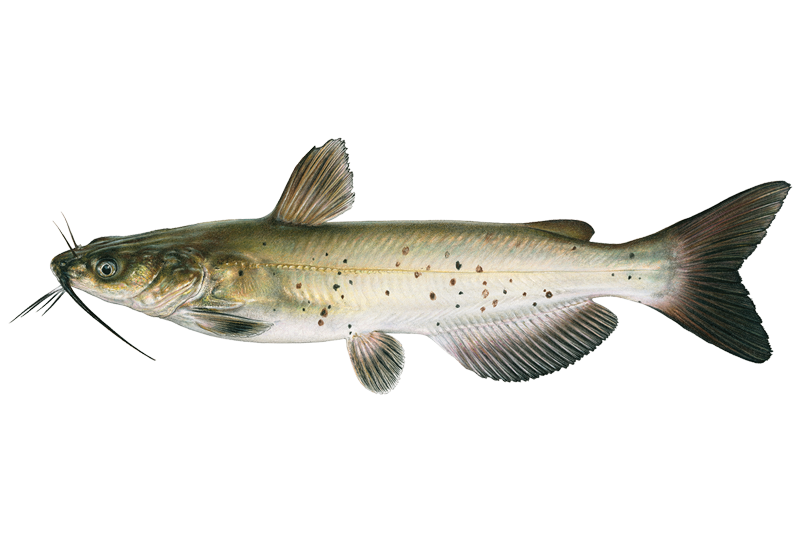
Channel catfish arrived in Brazil in 1980 as an introduced aquaculture species from North America.
They've since found their way into reservoirs, rivers, and farm ponds across southern and southeastern Brazil, where anglers target them for their strong runs and willingness to take a wide range of baits.
Research at stations in Rio Grande do Sul confirmed they grow faster in Brazilian conditions than native catfish species.
Scientific Name: Ictalurus punctatus
Also known as bagre-do-canal, channel cat
- Slender, scaleless body; pale blue to olive on the back and sides, white belly, with scattered dark spots that fade on larger fish.
- Deeply forked tail — the clearest way to tell a channel cat from a flathead; the fork is more pronounced than on most native Brazilian catfish.
- Eight sensory barbels (whiskers) around the mouth, covered in taste buds that help the fish locate food in murky water.
- Common fish run 1–3 lb in Brazilian waters; aquaculture trials recorded juveniles reaching several hundred grams within a single growing season.
What to know
Habitat Distribution
- Introduced to Brazil in 1980; not native. Established in reservoirs, rivers, and earthen aquaculture ponds across the south and southeast.
- Research and stocking activity documented in Rio Grande do Sul, São Paulo (Represa Billings, Represa Guarapiranga, Rio Grande), and Minas Gerais (Três Marias).
- Tolerates a wide range of freshwater types — slow reservoirs, moderate-current rivers, and still farm ponds — which helped it establish quickly after introduction.
- Water temperatures recorded during Brazilian trials ranged from 13 to 29°C, with an average around 21°C, suggesting the species handles the seasonal swings of southern Brazil well.
Key Locations
- Represa Billings and Represa Guarapiranga, São Paulo — large urban reservoirs with documented channel catfish presence.
- Rio Grande, São Paulo state — river system with reported catches.
- Três Marias reservoir, Minas Gerais — one of the larger impoundments in the region with catfish records.
- Rio Grande do Sul — site of formal aquaculture performance trials at the Chasqueiro Fish Breeding Station; fish are present in farm pond systems across the state.
Specific Spots
- Deep holes and channel edges in reservoirs — channel cats follow the bottom contour and hold where current slows and organic matter settles.
- Undercut banks, submerged timber, and rocky ledges provide the dark, sheltered cavities this species gravitates toward, especially during daylight hours.
- Inflow points where streams enter reservoirs concentrate baitfish and carry scent trails that draw feeding fish from downstream.
- Shallow flats adjacent to deep water at night — channel cats move up to feed after dark, so working the transition zone between 1 and 4 meters pays off.
Channel Catfish FAQ
Answers from onWater's species guide.
What are the best lures and bait for Channel Catfish?
Cut fish (sardines, tilápia scraps), chicken liver, and shrimp are the most reliable natural baits, all release strong scent plumes that channel cats track across the bottom.
When is the best time to fish for Channel Catfish?
Warmer months (October through March) bring the most active feeding as water temperatures rise and fish move shallower at night. Spawning activity occurs in spring and early summer (roughly September–November in southern Brazil) when water warms to around 22–23°C.
How do you catch Channel Catfish?
Most anglers in Brazil fish for channel cats from the bank or anchored boat, using bottom rigs with scent-heavy natural baits set out after dark. Rods are placed in holders and lines left to soak near structure, deep holes, submerged timber, or inflow channels, while anglers wait for a run.
What do Channel Catfish eat?
Bottom-oriented feeders that locate food almost entirely by smell and taste. In Brazilian waters, cut fish, shrimp, and chicken liver are go-to baits, the stronger the scent, the better. Sardines and other oily seafood work well for the same reason.
Where do Channel Catfish live?
Introduced to Brazil in 1980; not native. Established in reservoirs, rivers, and earthen aquaculture ponds across the south and southeast. Research and stocking activity documented in Rio Grande do Sul, São Paulo (Represa Billings, Represa Guarapiranga, Rio Grande), and Minas Gerais (Três Marias).
See it in the app
Most maps show you water.
onWater shows you Channel Catfish.



- 01 · Species map filter
Map every Channel Catfish water
Pick Channel Catfish and the map zeroes in on the waters they call home. No more guessing which lake holds them.
- 02 · Waterbody species
Tap any water. See what lives there.
Species, behavior and seasonal patterns for every lake, river and pond, before you leave the driveway.
- 03 · Angler Intelligence
Ask how to catch Channel Catfish
Tactics, gear and timing from onWater's AI fishing guide, tuned to the species and the water you're on.
Stop guessing where Channel Catfish are.
Open the map, filter by Channel Catfish, and head to water that holds them. Download onWater and plan your next trip in minutes.
- Species map filter
- Angler Intelligence
- Fishing journal
Explore other species
Trout, bass, salmon, panfish and everything in between. Each guide unpacks the behavior, seasons, and tactics that put fish in the net.
No species information available.

Smarter Fishing Starts in the App.
onWater Fish gives you everything you need to plan smarter, fish better, and own every trip from first cast to last.