Rainbow Trout
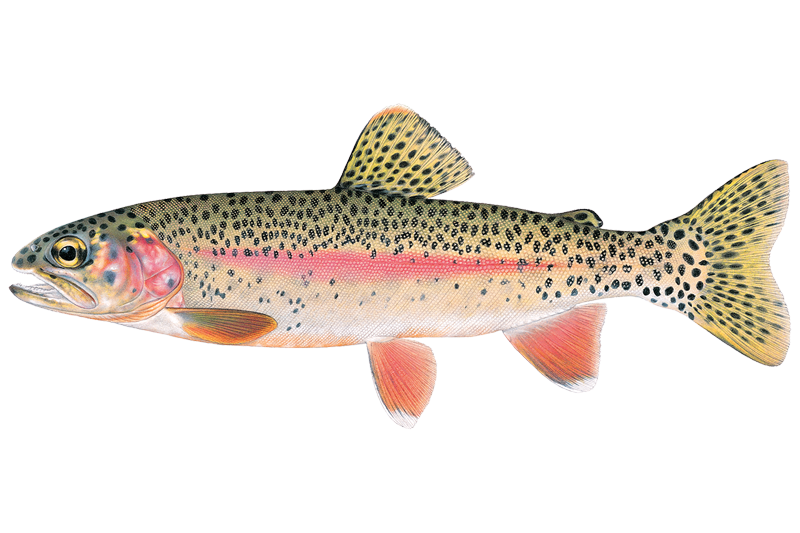
Rainbow trout are the backbone of freshwater sport fishing across Australia's southern states.
Introduced from North America via New Zealand in the late 19th century, they've been stocked and, in many places, self-sustaining in cold highland rivers and lakes across Tasmania, Victoria, NSW, and parts of SA and WA for well over a century.
They're the fish that gets most Australians into freshwater fishing.
Scientific Name: Oncorhynchus mykiss
Also known as Rainbow, Rainbows, Bow
- Dark olive-green to blue-grey back fading to silver-white belly, with a distinctive pink-to-red lateral stripe running from the gill plate toward the tail.
- Body and head heavily covered in small black spots, including on the dorsal fin and belly — the clearest visual separator from brown trout, which lack belly spots.
- Tail is square and broad, another reliable ID feature; spawning fish deepen in colour, with males developing a pronounced jaw hook (kype).
- River fish typically run 0.5–3 kg; anything over 3–4 kg is a genuinely good fish. Lake and dam fish can push past 5 kg in productive impoundments.
What to know
Habitat Distribution
- Introduced — not native to Australia. First stocked in the 1890s, now established across cooler southern waters through a mix of ongoing stocking programs and wild spawning.
- Core range covers highland rivers and lakes in Tasmania, Victoria, the Snowy Mountains of NSW, the Adelaide Hills in SA, and stocked rivers in south-west WA including the Blackwood, Warren, and Donnelly systems.
- In rivers, they need cold (5–20°C), fast-flowing, well-oxygenated water over gravel or rocky substrate — typically upper catchments and mountain tributaries.
- Also found in deep, cold lakes and impoundments where summer surface temperatures stay low enough; these still-water fisheries are often open year-round when rivers are closed.
Key Locations
- Tasmania — the Great Lake, Arthurs Lake, and the Central Plateau lakes system are among the most productive still-water rainbow fisheries in the country.
- Snowy Mountains, NSW — the Eucumbene River and Lake Jindabyne are well-known destinations, with both river and impoundment fishing available.
- Victorian High Country — rivers like the Mitta Mitta, Ovens, and Howqua hold wild and stocked rainbows in classic mountain stream country.
- South-west WA — the Blackwood, Warren, Donnelly, and Collie rivers below Wellington Dam are stocked annually from the Pemberton hatchery, giving accessible river fishing in the region.
Specific Spots
- In rivers, work the seams where fast water meets slow — the edge of a riffle dropping into a pool is where rainbows hold to intercept drifting food without burning energy fighting current.
- Undercut banks and fallen timber provide shade and cover; fish often sit tight against structure, especially in clear water where they're easily spooked.
- In lakes and dams, focus on drop-offs, inlet streams, and weed edges — inflows bring oxygenated, cooler water and concentrate food, particularly after rain.
- During summer, move to deeper water or shaded reaches; rainbows push into the upper water column early morning and late afternoon when surface temperatures cool.
Rainbow Trout FAQ
Answers from onWater's species guide.
What are the best lures and bait for Rainbow Trout?
Small hard-body minnow lures (4–7 cm) in natural baitfish colours, silver, gold, or brown trout patterns, are reliable across rivers and lakes; cast across current and work them with a twitch-and-pause retrieve or let them swing through a pool.
What flies work for Rainbow Trout?
Nymphs are the most productive flies year-round, a Pheasant Tail (mayfly nymph) and Hare's Ear (general invertebrate) in sizes 12–16 cover most situations; dead-drift them (let the fly drift naturally with the current, no added movement) under a strike indicator or tight-line style through runs and pools.
When is the best time to fish for Rainbow Trout?
River seasons are regulated and vary by state, with rivers typically closed during the winter spawning period; always check current state rules before fishing a river. Lakes and impoundments are generally open year-round, making them the go-to option during river closed seasons.
How do you catch Rainbow Trout?
Most anglers wade or walk river banks, casting upstream with lures or flies and working runs, riffles, and pool edges. Lake fishing is done from shore or small boats, covering drop-offs and inlet areas with lures or bait. Stealth matters, approach slowly, stay low on clear streams, and keep shadows off the water.
What do Rainbow Trout eat?
Aquatic insects make up the bulk of the diet in rivers, mayfly nymphs, caddis larvae, and midges year-round. Match these with nymph patterns like a Pheasant Tail (mayfly nymph imitation) or Hare's Ear (general nymph), or soft-plastic and metal lures worked slowly near the bottom.
See it in the app
Most maps show you water.
onWater shows you Rainbow Trout.



- 01 · Species map filter
Map every Rainbow Trout water
Pick Rainbow Trout and the map zeroes in on the waters they call home. No more guessing which lake holds them.
- 02 · Waterbody species
Tap any water. See what lives there.
Species, behavior and seasonal patterns for every lake, river and pond, before you leave the driveway.
- 03 · Angler Intelligence
Ask how to catch Rainbow Trout
Tactics, gear and timing from onWater's AI fishing guide, tuned to the species and the water you're on.
Stop guessing where Rainbow Trout are.
Open the map, filter by Rainbow Trout, and head to water that holds them. Download onWater and plan your next trip in minutes.
- Species map filter
- Angler Intelligence
- Fishing journal
Explore other species
Trout, bass, salmon, panfish and everything in between. Each guide unpacks the behavior, seasons, and tactics that put fish in the net.
No species information available.
Smarter Fishing Starts in the App.
onWater Fish gives you everything you need to plan smarter, fish better, and own every trip from first cast to last.