Common Carp
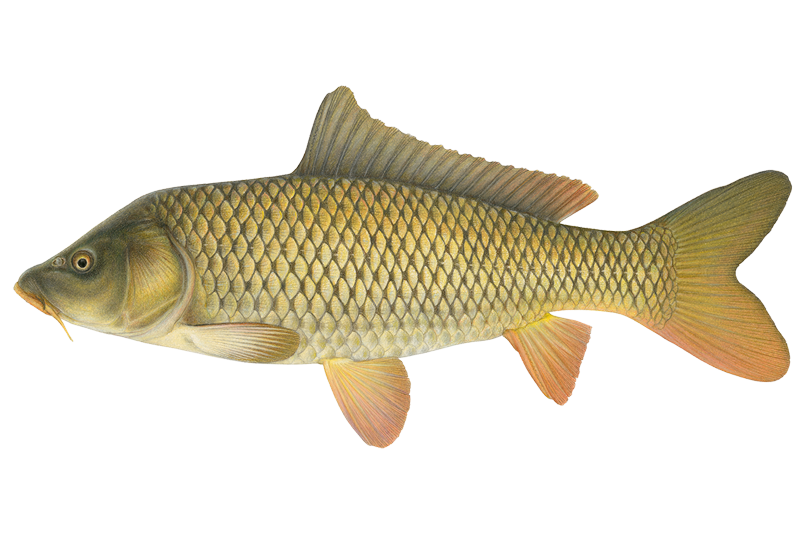
Common carp are an introduced pest fish that now dominate much of south-east Australia's freshwater — particularly the Murray-Darling Basin — yet a growing number of Australian anglers target them deliberately.
They're large, wary, and strong, which makes them a genuine challenge on light gear. The fishing community is increasingly recognising carp as a legitimate sport fish, even as management agencies work to reduce their numbers.
Scientific Name: Cyprinus carpio
Also known as European carp, koi carp, mirror carp, leather carp
- Olive-green to bronze-gold on the back, fading to silvery yellow on the sides and pale on the belly; fins often reddish-tinged.
- Two pairs of fleshy barbels at the corners of the upper lip — the clearest way to tell carp from goldfish, which have no barbels.
- Large, prominent scales; a single long dorsal fin with a strongly serrated leading spine; deeply forked tail.
- Most fish caught in Australia run 4–5 kg; fish to 10 kg exist in the Murray-Darling system.
What to know
Habitat Distribution
- Introduced — not native to Australia. First brought in during the 1800s; the so-called 'Boolara' strain released in Victoria in 1961 spread rapidly and now dominates inland waters.
- Most abundant in the Murray-Darling Basin across Queensland, NSW, Victoria and South Australia; also present in coastal drainages of NSW and Victoria, and in some Perth-area wetlands in WA.
- Favour warm, slow or still water with silty bottoms and aquatic vegetation — irrigation channels, weir pools, lakes, river backwaters and lowland reaches.
- Rarely found in clear, fast-flowing upland streams; most populations sit below about 700 m elevation.
Key Locations
- Murray River (NSW/VIC/SA) — the main stem and its weir pools hold some of the densest carp populations in the country.
- Murrumbidgee River (NSW) — one of the earliest introduction sites; carp are abundant throughout the lowland reaches.
- Condamine-Balonne catchment (QLD) — the northern extent of the Murray-Darling system; carp present in the main rivers and tributaries.
- Coastal lakes and lagoons of NSW and Victoria — including brackish systems near river mouths where carp tolerate the salinity.
- Perth-area wetlands (WA) — a smaller, isolated population but present and fishable.
Specific Spots
- Weir pools and lock pools concentrate carp year-round — the slack water and food-rich silt make them reliable holding areas.
- Shallow, weedy margins in early morning and evening, where carp root through soft bottom and suck insects from the surface film.
- Undercut banks, submerged timber and bridge pylons give carp shade and a sense of cover; fish tight to structure.
- Irrigation channel inflows and drain outlets attract feeding fish, especially after rain flushes food into the system.
Common Carp FAQ
Answers from onWater's species guide.
What are the best lures and bait for Common Carp?
Dough baits, bread flake, and sweet corn are the most accessible starting points, cheap, effective, and easy to present on a simple running sinker rig on the bottom.
What flies work for Common Carp?
Nymphs fished slowly along the bottom are the most reliable fly approach, Pheasant Tail Nymphs and Hare's Ear Nymphs imitate the aquatic insect larvae carp grub for in the silt.
When is the best time to fish for Common Carp?
Spring (September–November), fish feed heavily as water warms after winter; pre-spawn fish are at their most active and catchable. Summer (December–February), best fishing in early morning and evening; midday heat pushes fish deep and slows feeding.
How do you catch Common Carp?
Most Australian carp anglers fish from the bank, pre-baiting a swim with corn or boilies and presenting a bait on a running sinker or hair rig on the bottom. Fly anglers wade shallow margins and sight-cast to tailing fish in weedy bays and irrigation channels.
What do Common Carp eat?
Carp are bottom-grubbers by nature, they suck up mouthfuls of silt and strain out worms, insect larvae, crustaceans and plant matter using pharyngeal (throat) teeth. Dough baits, corn, and boilies (flavoured paste balls) all mimic this soft, bottom-level feeding style.
See it in the app
Most maps show you water.
onWater shows you Common Carp.



- 01 · Species map filter
Map every Common Carp water
Pick Common Carp and the map zeroes in on the waters they call home. No more guessing which lake holds them.
- 02 · Waterbody species
Tap any water. See what lives there.
Species, behavior and seasonal patterns for every lake, river and pond, before you leave the driveway.
- 03 · Angler Intelligence
Ask how to catch Common Carp
Tactics, gear and timing from onWater's AI fishing guide, tuned to the species and the water you're on.
Stop guessing where Common Carp are.
Open the map, filter by Common Carp, and head to water that holds them. Download onWater and plan your next trip in minutes.
- Species map filter
- Angler Intelligence
- Fishing journal
Explore other species
Trout, bass, salmon, panfish and everything in between. Each guide unpacks the behavior, seasons, and tactics that put fish in the net.
No species information available.
Smarter Fishing Starts in the App.
onWater Fish gives you everything you need to plan smarter, fish better, and own every trip from first cast to last.