Chinook Salmon
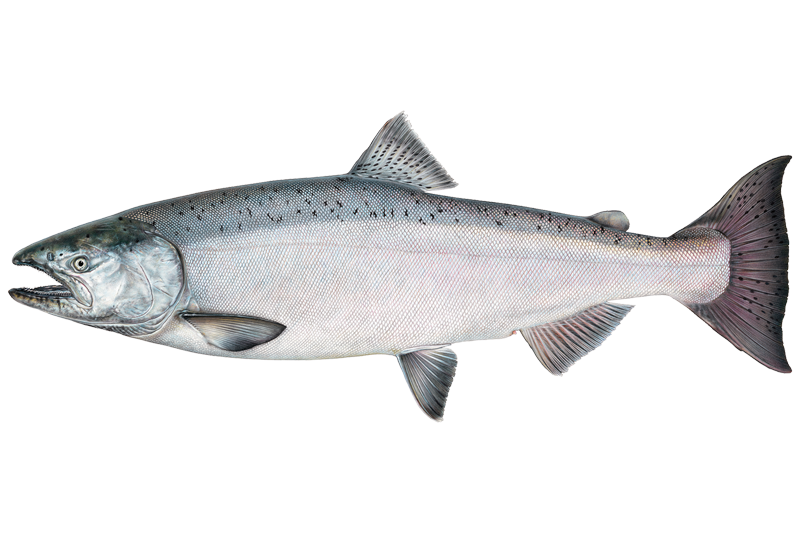
Chinook salmon were introduced to Australia in the 1870s and never established self-sustaining wild populations.
Today the fishery exists almost entirely through stocking by the Victorian Fisheries Authority, concentrated in two volcanic crater lakes in south-west Victoria — Lake Purrumbete and Lake Bullen Merri.
For Victorian anglers, these lakes are the only realistic shot at a Chinook in Australian freshwater.
Scientific Name: Oncorhynchus tshawytscha
Also known as King salmon, quinnat salmon, blackmouth
- Blue-green back with silvery sides and white belly in freshwater; black spots on the upper body and on both lobes of the tail fin — the spotted tail distinguishes Chinook from Atlantic salmon.
- Black pigment along the gum line gives rise to the "blackmouth" nickname — a reliable field ID mark when the fish is in hand.
- Spawning males develop a pronounced hooked upper jaw and shift to olive-brown or reddish colouring; females stay more torpedo-shaped with a blunter nose.
- Typical stocked fish in the Victorian crater lakes run 2–5 kg; larger individuals pushing 8–10 kg are possible as fish mature over multiple seasons.
What to know
Habitat Distribution
- Introduced — not native to Australia. First brought over in the 1870s; wild self-sustaining populations never established, so the fishery depends entirely on ongoing stocking.
- In Australia, Chinook are effectively confined to Lake Purrumbete and Lake Bullen Merri in south-west Victoria — two deep, cold volcanic crater lakes near Camperdown.
- Both lakes are cold, clear, and deep enough to hold a thermocline through summer, giving the fish the cold-water refuge they need to survive the warmer months.
Key Locations
- Lake Bullen Merri, south-west Victoria — one of the two primary stocked crater lakes; boat fishing with downriggers or paravanes to reach the thermocline is the standard approach here.
- Lake Purrumbete, south-west Victoria — the other crater lake in the Camperdown district; accessible to shore-based anglers as well as boats, with good low-light surface fishing along the margins.
Specific Spots
- In low light — dawn and dusk — Chinook push toward the surface and the shallower margins, actively chasing small baitfish; this is prime time for shore casters and shallow trollers.
- Once the sun is up, fish drop to the thermocline — the layer where cold and warm water meet. Locating this depth on a sounder and getting lures or bait into that zone is the key to midday success from a boat.
- Rocky points, drop-offs, and any structure that concentrates baitfish will hold Chinook; work these edges before moving to open water.
Chinook Salmon FAQ
Answers from onWater's species guide.
What are the best lures and bait for Chinook Salmon?
Tasmanian Devils and diving minnow-style crankbaits are the proven trolling lures on the Victorian crater lakes, vary the depth and speed until you find what's working on the day.
What flies work for Chinook Salmon?
Baitfish-pattern streamers, Clouser Minnows (which imitate small fish) and Woolly Buggers (a general attractor that also reads as a small fish or large invertebrate), are the workhorses. Strip them on a sinking line through the depth where fish are holding.
When is the best time to fish for Chinook Salmon?
Autumn and winter (March–August), cooler water temperatures keep fish active across a wider range of depths and extend the productive fishing window through the day. Spring (September–November), fish remain active as water warms; surface and near-surface feeding in low light can be particularly good.
How do you catch Chinook Salmon?
Most anglers target Chinook in the Victorian crater lakes by trolling minnow lures or rigged pilchards at thermocline depth from a boat, using a sounder to locate fish first. Shore-based anglers work the margins at dawn and dusk with cast lures or bait, focusing on the low-light windows when fish move shallow.
What do Chinook Salmon eat?
Juveniles feed on insects and small crustaceans; as they grow, their diet shifts almost entirely to small fish, in the crater lakes, that means whatever baitfish (glassies, small perch) are available. Minnow-profile lures and baitfish-pattern flies directly imitate this.
See it in the app
Most maps show you water.
onWater shows you Chinook Salmon.



- 01 · Species map filter
Map every Chinook Salmon water
Pick Chinook Salmon and the map zeroes in on the waters they call home. No more guessing which lake holds them.
- 02 · Waterbody species
Tap any water. See what lives there.
Species, behavior and seasonal patterns for every lake, river and pond, before you leave the driveway.
- 03 · Angler Intelligence
Ask how to catch Chinook Salmon
Tactics, gear and timing from onWater's AI fishing guide, tuned to the species and the water you're on.
Stop guessing where Chinook Salmon are.
Open the map, filter by Chinook Salmon, and head to water that holds them. Download onWater and plan your next trip in minutes.
- Species map filter
- Angler Intelligence
- Fishing journal
Explore other species
Trout, bass, salmon, panfish and everything in between. Each guide unpacks the behavior, seasons, and tactics that put fish in the net.
No species information available.

Smarter Fishing Starts in the App.
onWater Fish gives you everything you need to plan smarter, fish better, and own every trip from first cast to last.