Brown Trout
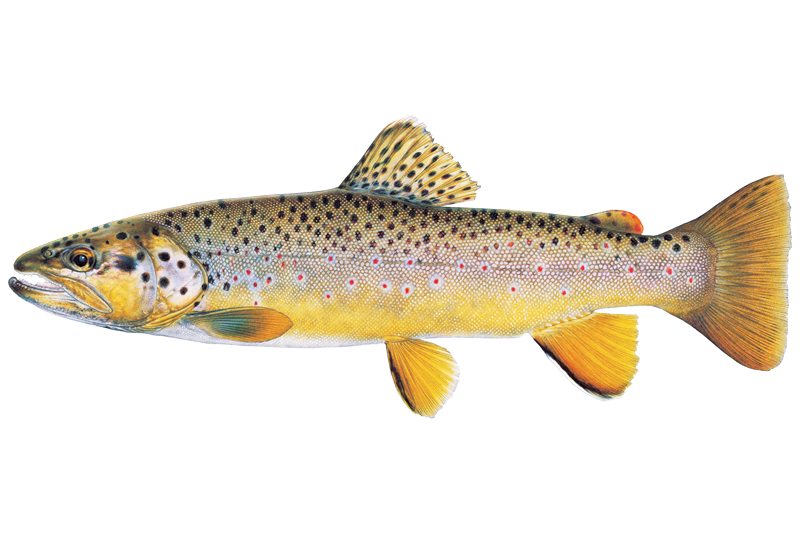
Brown trout arrived in Tasmania in 1864 — the first successful trout introduction in Australia — and have since spread through cool-water rivers, lakes and reservoirs across Victoria, NSW, the ACT, South Australia and south-western WA.
They form the backbone of freshwater sport fishing in the southern states, drawing anglers to alpine streams and highland lakes that few other species could sustain.
Scientific Name: Salmo trutta
Also known as Brownie, Loch Leven trout, Sea trout (sea-run fish)
- Stout, deep-bodied fish with a large mouth that extends back past the eye — noticeably heavier in the head and shoulders than a rainbow trout of the same length.
- Colouration ranges from rich olive-brown with bold black and reddish-orange spots (river fish) to near-silver with faint markings (lake and sea-run fish); spots on the sides are usually ringed by a pale halo.
- No spots on the tail — the clearest field mark separating browns from rainbows, which have black spots across the entire tail. The adipose fin has a distinctive orange-red rear edge.
- Typically caught at 1–4 kg in Australian waters; fish over 5 kg are genuinely large, and the species can reach 10 kg in exceptional circumstances.
What to know
Habitat Distribution
- Introduced from Europe; not native to Australia. Self-sustaining wild populations exist in higher-altitude streams and lakes of NSW, the ACT, Victoria and Tasmania, with stocked populations in SA and south-western WA.
- Requires cool, well-oxygenated water — alpine and sub-alpine rivers and streams with moderate to swift current over gravel or cobble are the classic habitat.
- Also found in deep, cold highland lakes and reservoirs, where fish often grow larger than their river counterparts due to abundant baitfish forage.
- Sea-run fish (called sea trout) move into estuaries and coastal waters in some areas; anglers in Port Phillip Bay, Victoria have caught them in saltwater.
Key Locations
- Tasmania — the Plenty River, Derwent River system and Great Lake have supported brown trout since the original 1864 introduction; Tasmania remains one of Australia's premier trout destinations.
- Snowy Mountains, NSW — the Eucumbene River and Lake Jindabyne hold good populations, with alpine streams in the Kosciuszko region producing wild fish.
- Victorian Alps — rivers including the Mitta Mitta, Ovens and upper Murray tributaries carry self-sustaining wild brown trout populations.
- South-western WA — the Warren, Donnelly and Collie rivers, along with reservoirs such as Big Brook Dam and Waroona Dam, are stocked and hold some self-sustaining fish.
Specific Spots
- In rivers, look for fish holding just ahead of or behind large boulders and submerged timber — these current breaks let browns sit in slack water while food drifts past.
- Undercut banks and overhanging vegetation are prime lies, especially during daylight; browns use the shade for cover and intercept terrestrial insects that fall from above.
- In lakes, work the drop-offs where shallow weed flats fall away into deeper water — fish cruise these edges, particularly at dawn and dusk, hunting baitfish and invertebrates.
- Tail-outs of pools (the shallow, slick water at the downstream end) concentrate feeding fish during insect hatches, when browns move out of deeper holding water to rise.
Brown Trout FAQ
Answers from onWater's species guide.
What are the best lures and bait for Brown Trout?
Small minnow-style hard-body lures (4–7 cm) in natural baitfish colours, gold, brown trout, or olive, are the go-to for river spinning. Twitched or retrieved with pauses, they draw strikes from fish holding behind structure.
What flies work for Brown Trout?
Nymphs are the most consistent producers in rivers: Pheasant Tail nymphs (imitating mayfly nymphs) and Hare's Ear nymphs (a general invertebrate imitation) dead-drifted, floated naturally with the current, through runs and pools account for a large share of fish.
When is the best time to fish for Brown Trout?
Opening of the trout season varies by state but generally falls in late winter to early spring (August–September in most southern states), with rivers fishing well through spring as water temperatures rise and insect activity increases.
How do you catch Brown Trout?
Most anglers wade or walk river banks, working upstream and presenting lures or flies to visible fish or likely holding water. Lake fishing is done from shore or small boats, covering drop-offs and weed edges at dawn and dusk.
What do Brown Trout eat?
Aquatic insect larvae, mayfly nymphs, caddis larvae and midge pupae, make up the bulk of the diet in rivers. Match these with nymph patterns like a Pheasant Tail (mayfly nymph imitation) or Hare's Ear (general nymph), or soft-hackle wet flies swung through the current.
See it in the app
Most maps show you water.
onWater shows you Brown Trout.



- 01 · Species map filter
Map every Brown Trout water
Pick Brown Trout and the map zeroes in on the waters they call home. No more guessing which lake holds them.
- 02 · Waterbody species
Tap any water. See what lives there.
Species, behavior and seasonal patterns for every lake, river and pond, before you leave the driveway.
- 03 · Angler Intelligence
Ask how to catch Brown Trout
Tactics, gear and timing from onWater's AI fishing guide, tuned to the species and the water you're on.
Stop guessing where Brown Trout are.
Open the map, filter by Brown Trout, and head to water that holds them. Download onWater and plan your next trip in minutes.
- Species map filter
- Angler Intelligence
- Fishing journal
Explore other species
Trout, bass, salmon, panfish and everything in between. Each guide unpacks the behavior, seasons, and tactics that put fish in the net.
No species information available.

Smarter Fishing Starts in the App.
onWater Fish gives you everything you need to plan smarter, fish better, and own every trip from first cast to last.