Brook Trout
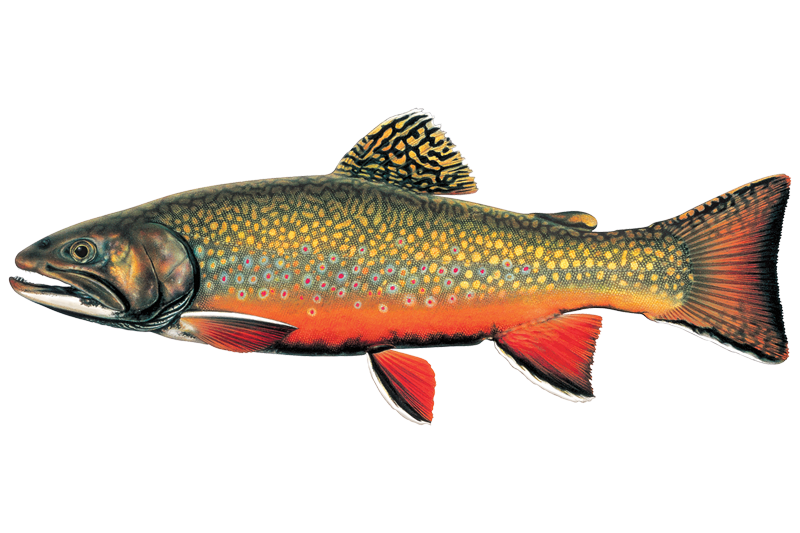
Brook trout are a North American char introduced to Australia in the 1870s, now found in a handful of cold highland waters in NSW and Tasmania.
They're the smallest of the three trout species here, but what they lack in size they make up for in colour — few freshwater fish in Australia are as visually striking.
Wild self-sustaining populations are rare and localised, making a brook trout a genuine find.
Scientific Name: Salvelinus fontinalis
Also known as Brook char, brookie
- Dark olive-green back with irregular worm-like markings (vermiculations); sides carry red spots ringed with blue halos — unmistakable at close range.
- Fins are distinctive: lower fins (pelvic and anal) show white leading edges followed by a black stripe, then orange-red — a reliable ID feature separating them from brown and rainbow trout.
- Very large mouth extending well behind the eye; tail shallowly forked rather than square like a rainbow's.
- Typical Australian fish run well under 1 kg; specimens to 2 kg are considered solid, with a recorded Australian maximum around 4 kg.
What to know
Habitat Distribution
- Introduced from North America in the 1870s — not native to Australia. Most stocking attempts failed to produce self-sustaining populations.
- On mainland Australia, only a tiny number of wild populations persist: one in the New England Tablelands (a Dungowan Creek tributary in the Peel River catchment, NSW) and one in Ogilvies Creek in the upper Murray catchment.
- Tasmania has the most reliable populations, with Clarence Lagoon holding a reproducing population and regular stocking maintaining fishable numbers in select highland lakes and streams.
- Require cold, clear, well-oxygenated water — highland streams and alpine lakes above the snowline country are the only Australian environments that consistently suit them.
Key Locations
- Clarence Lagoon, Tasmania — one of the few confirmed self-sustaining populations in Australia, regularly stocked and fishable.
- Ogilvies Creek, upper Murray catchment, NSW — a rare mainland wild population stemming from fingerling stockings in the late 1980s and early 1990s.
- Dry Dam on Eight Mile Creek near Cabramurra, Tumut River catchment, NSW — the primary mainland stocking site, receiving several thousand fingerlings annually.
- New England Tablelands, NSW — a tributary of Dungowan Creek (Peel River catchment) holds a small wild population, though its current status after drought years is uncertain.
Specific Spots
- Deep pools below riffles and undercut banks in small alpine streams — brook trout hold in slower water adjacent to current where food is delivered to them.
- Overhanging vegetation and root systems provide shade and terrestrial insect fall; these edges are worth working carefully, especially in summer when water warms.
- In lakes, look for inlet streams and spring-fed shallows — brook trout gravitate toward the coldest, most oxygenated water, particularly as surface temperatures rise.
- Gravel runs and riffles become key during autumn spawning, when fish move up from pools to find clean substrate.
Brook Trout FAQ
Answers from onWater's species guide.
What are the best lures and bait for Brook Trout?
Small spinners (sizes 0–2) in gold or silver are reliable across all Australian brook trout water, the flash and vibration draw strikes even in tight, shaded pools. Miniature minnow-style hard-body lures worked with a slow, erratic retrieve through pools and along undercut banks account for the larger fish.
What flies work for Brook Trout?
Nymphs fished dead-drift are the most consistent producers: Pheasant Tail nymphs (imitating mayfly nymphs) and Hare's Ear nymphs (covering a broad range of subsurface invertebrates) in sizes 14–18 cover most situations.
When is the best time to fish for Brook Trout?
Spring (September–November): water temperatures rise from winter lows, fish become more active and begin feeding heavily, good dry fly and nymph fishing as aquatic insect activity picks up.
How do you catch Brook Trout?
Most Australian brook trout fishing happens on foot, working small alpine streams carefully from downstream to avoid spooking fish. Fly fishing with nymphs dead-drifted through pools and runs is the dominant method, though ultralight spinning with small spinners is equally effective.
What do Brook Trout eat?
Aquatic insects form the core of the diet, mayfly nymphs, caddis larvae, and midges drifting in the current. A Pheasant Tail nymph imitates mayfly nymphs; a Hare's Ear covers a range of subsurface bugs.
See it in the app
Most maps show you water.
onWater shows you Brook Trout.



- 01 · Species map filter
Map every Brook Trout water
Pick Brook Trout and the map zeroes in on the waters they call home. No more guessing which lake holds them.
- 02 · Waterbody species
Tap any water. See what lives there.
Species, behavior and seasonal patterns for every lake, river and pond, before you leave the driveway.
- 03 · Angler Intelligence
Ask how to catch Brook Trout
Tactics, gear and timing from onWater's AI fishing guide, tuned to the species and the water you're on.
Stop guessing where Brook Trout are.
Open the map, filter by Brook Trout, and head to water that holds them. Download onWater and plan your next trip in minutes.
- Species map filter
- Angler Intelligence
- Fishing journal
Explore other species
Trout, bass, salmon, panfish and everything in between. Each guide unpacks the behavior, seasons, and tactics that put fish in the net.
No species information available.
Smarter Fishing Starts in the App.
onWater Fish gives you everything you need to plan smarter, fish better, and own every trip from first cast to last.