Atlantic Salmon
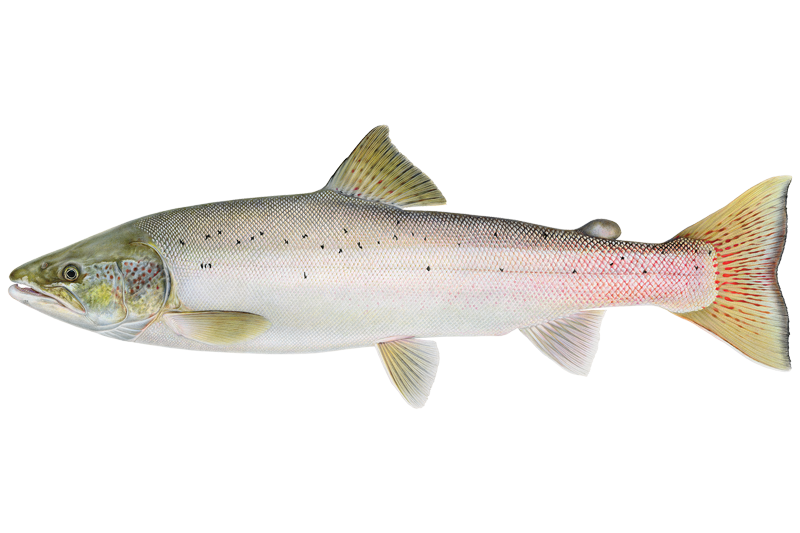
Atlantic salmon in Australia aren't a wild fishery in any traditional sense — they're introduced fish with no self-sustaining populations.
The practical fishery is built around aquaculture escapees in Tasmania's D'Entrecasteaux Channel and Huon estuary, plus stocked fish in a handful of NSW impoundments. Most fish run 1–3 kg, with anything over 6 kg genuinely rare.
Scientific Name: Salmo salar
Also known as Salmon, black salmon
- Predominantly silver with a blue-green back and silvery-white belly; black, often X-shaped spots on the sides and top of the head, with few or none below the lateral line.
- Distinguished from Brown Trout by a smaller mouth that doesn't extend past the eye, a more deeply forked tail, a slender caudal peduncle, and no orange margin on the adipose fin.
- Typical Australian fish run 1–3 kg; fish over 6 kg are rare here, though the species reaches 38 kg in its native North Atlantic range.
- Mature males develop a pronounced hook (kype) on the lower jaw; colouration shifts with lifecycle stage and sex.
What to know
Habitat Distribution
- Introduced — not native to Australia. No self-sustaining wild populations exist; the species was first brought here in the 1800s and again in the 1960s, without establishing.
- Tasmania's marine recreational fishery is based entirely on escapees from aquaculture farms concentrated along the D'Entrecasteaux Channel and Huon estuary.
- In NSW, fish have been stocked into cool impoundments including Lake Jindabyne and Burrinjuck Dam, though returns are described as marginal.
- Requires cool water — thrives in the colder waters of southern Tasmania; freshwater growth in Australian conditions is generally slow.
Key Locations
- D'Entrecasteaux Channel, Tasmania — the main marine recreational fishery, based around escapees from salmon farms along the channel's length.
- Huon estuary, Tasmania — closely associated with the channel fishery; farms and escapees are concentrated in this region.
- Macquarie Harbour, Tasmania — Rainbow Trout and occasional Atlantic salmon are taken here.
- Lake Jindabyne, NSW — one of the impoundments where Atlantic salmon have been stocked, though returns are marginal.
Specific Spots
- In the D'Entrecasteaux Channel, rocky shorelines with deep drop-offs close to shore hold escapee fish — the depth change gives them somewhere to sit between feeding forays.
- Headlands and rocky outcrops along the channel concentrate fish after a farm escape, which is when most are encountered in numbers.
- In NSW impoundments, fish relate to deeper, cooler sections of the lake, particularly during warmer months when surface temperatures rise.
Atlantic Salmon FAQ
Answers from onWater's species guide.
What are the best lures and bait for Atlantic Salmon?
Small soft plastic lures (2-inch paddle or curl-tail grubs) work well for Tasmanian escapees fished along rocky channel shorelines. Natural baits are also taken by rod and line in Tasmanian waters, the same baitfish presentations that work for other salmonids apply here.
What flies work for Atlantic Salmon?
In Tasmanian marine waters, small baitfish-imitating streamers, Clouser Minnows or Woolly Buggers, retrieved along rocky drop-offs produce fish.
When is the best time to fish for Atlantic Salmon?
Open all year in Tasmania, there is no closed season for Atlantic salmon. Fishing is most productive in the days immediately following a farm escape, which can happen at any time of year. Cooler months (autumn through spring) generally suit the species better given its preference for cold water.
How do you catch Atlantic Salmon?
Most Tasmanian fish are taken by gillnet in the D'Entrecasteaux Channel and Huon estuary, but rod-and-line anglers work rocky shorelines from kayaks or small boats using light spinning gear or fly rods, drifting parallel to the shore.
What do Atlantic Salmon eat?
Aquaculture escapees in Tasmanian marine waters feed on whatever baitfish and invertebrates are available in the channel, they respond well to small soft plastics and natural baits fished near structure.
See it in the app
Most maps show you water.
onWater shows you Atlantic Salmon.



- 01 · Species map filter
Map every Atlantic Salmon water
Pick Atlantic Salmon and the map zeroes in on the waters they call home. No more guessing which lake holds them.
- 02 · Waterbody species
Tap any water. See what lives there.
Species, behavior and seasonal patterns for every lake, river and pond, before you leave the driveway.
- 03 · Angler Intelligence
Ask how to catch Atlantic Salmon
Tactics, gear and timing from onWater's AI fishing guide, tuned to the species and the water you're on.
Stop guessing where Atlantic Salmon are.
Open the map, filter by Atlantic Salmon, and head to water that holds them. Download onWater and plan your next trip in minutes.
- Species map filter
- Angler Intelligence
- Fishing journal
Explore other species
Trout, bass, salmon, panfish and everything in between. Each guide unpacks the behavior, seasons, and tactics that put fish in the net.
No species information available.
Smarter Fishing Starts in the App.
onWater Fish gives you everything you need to plan smarter, fish better, and own every trip from first cast to last.