Rainbow Trout
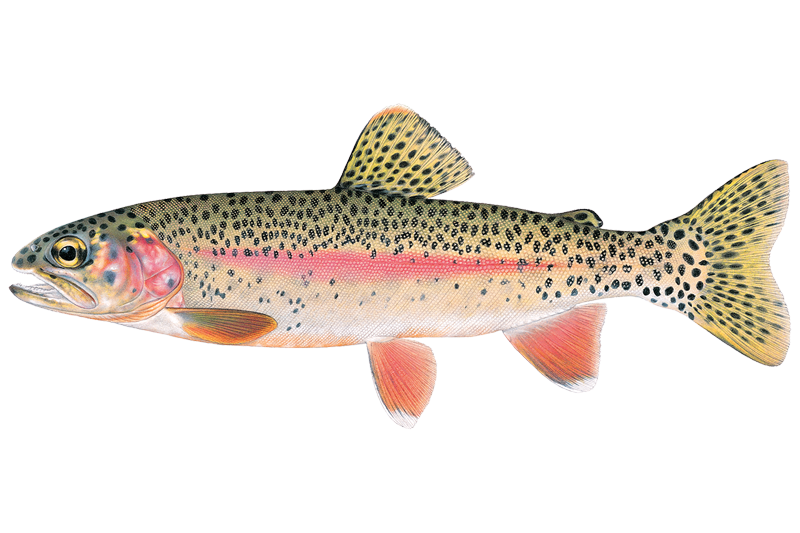
Rainbow trout are the most widely distributed trout in Argentine Patagonia, introduced from the United States in 1904 and now thriving across rivers, lakes, and lagoons from the lake district south to Santa Cruz province.
Lago Strobel (Jurassic Lake) has made Argentina a destination unto itself — a remote plateau lake where wild rainbows averaging 6–8 lbs are routine and fish over 20 lbs are caught every season.
Scientific Name: Oncorhynchus mykiss
Also known as Trucha arcoíris, trucha arco iris
- Olive back, silver sides with a broad pink-to-crimson lateral band running from gill plate to tail — the most reliable field mark separating rainbows from brown or brook trout.
- Dense black spots cover the back, dorsal fin, and tail; the anal fin sometimes shows a white outer edge on stream-resident fish.
- Lake fish near glacial water tend toward darker backs, brighter silver sides, and a white belly — the chrome-bright look Lago Strobel fish are known for.
- Typical river fish run 1–4 lbs; lake fish in Patagonia regularly reach 6–12 lbs, with specimens over 20 lbs documented at Lago Strobel.
What to know
Habitat Distribution
- Introduced, not native — first stocked in Patagonia in 1904 from North American stock, now naturalized across rivers and lakes throughout Argentine Patagonia.
- Most abundant in the Andean lake district (Neuquén and Río Negro provinces) and south through Santa Cruz province, including the Santa Cruz River drainage.
- Occupy cold, clear rivers and spring-fed streams as well as large, deep Andean lakes and remote plateau lakes like Lago Strobel.
- A sea-run population exists in the Santa Cruz River, where fish migrate to the ocean and return at larger sizes — a behavior unusual for rainbows in South America.
Key Locations
- Lago Strobel (Jurassic Lake), Santa Cruz province — a remote plateau lake with extraordinary densities of large wild rainbows; the Barrancoso River mouth is the most productive single spot.
- Río Malleo, Neuquén province — one of Patagonia's most celebrated trout rivers, with consistent hatches and large resident rainbows and browns.
- Huaca Mamuil (tributary of the Malleo) — a spring-fed stream known for big, selective fish in intimate, clear water.
- Santa Cruz River, Santa Cruz province — home to a rare sea-run rainbow population that reaches exceptional sizes after ocean feeding migrations.
Specific Spots
- At Lago Strobel, productive bays, coves, and the mouth of the Barrancoso River concentrate fish — the inlet is where thousands of trout funnel and feeding activity peaks.
- In rivers like the Malleo, fish hold in current breaks, the heads and tails of runs, and behind mid-channel boulders where drifting food collects.
- Spring-fed tributaries (like the Huaca Mamuil off the Malleo) hold large, wary fish in clear, slow water — sight fishing with precise presentations is the game here.
- Along lake shorelines, cruising fish follow scud-rich shallows; sight fishing to individual fish in crystal water is the standard approach at Lago Strobel.
Rainbow Trout FAQ
Answers from onWater's species guide.
What are the best lures and bait for Rainbow Trout?
Small spinners (Mepps, Rooster Tail) and spoons work well in rivers and along lake margins, silver and gold finishes cover most conditions. Soft-plastic grubs and small jigs in natural colors produce in lakes, worked slowly along the bottom to imitate scuds and small baitfish.
What flies work for Rainbow Trout?
Scud patterns (small shrimp imitations in olive, pink, or tan, size 12–16) are the signature fly at Lago Strobel, stripped slowly or dead-drifted (allowed to drift naturally with the current) along the bottom in clear shallows.
When is the best time to fish for Rainbow Trout?
The main season across Patagonia runs roughly October through April (Southern Hemisphere spring through early fall), with the fishery closed during the winter months.
How do you catch Rainbow Trout?
Most anglers in Argentina pursue rainbows by wading rivers and sight-fishing to rising or cruising fish, or by working lake shorelines on foot. At Lago Strobel, the standard approach is sight fishing to individual cruising fish in clear shallows, casting scud patterns or small streamers ahead of moving fish.
What do Rainbow Trout eat?
Invertebrates form the core diet, aquatic insects (mayflies, caddisflies, stoneflies) in rivers, and freshwater scuds (small shrimp-like crustaceans) in lakes like Lago Strobel.
See it in the app
Most maps show you water.
onWater shows you Rainbow Trout.



- 01 · Species map filter
Map every Rainbow Trout water
Pick Rainbow Trout and the map zeroes in on the waters they call home. No more guessing which lake holds them.
- 02 · Waterbody species
Tap any water. See what lives there.
Species, behavior and seasonal patterns for every lake, river and pond, before you leave the driveway.
- 03 · Angler Intelligence
Ask how to catch Rainbow Trout
Tactics, gear and timing from onWater's AI fishing guide, tuned to the species and the water you're on.
Stop guessing where Rainbow Trout are.
Open the map, filter by Rainbow Trout, and head to water that holds them. Download onWater and plan your next trip in minutes.
- Species map filter
- Angler Intelligence
- Fishing journal
Explore other species
Trout, bass, salmon, panfish and everything in between. Each guide unpacks the behavior, seasons, and tactics that put fish in the net.
No species information available.
Smarter Fishing Starts in the App.
onWater Fish gives you everything you need to plan smarter, fish better, and own every trip from first cast to last.