Chinook Salmon
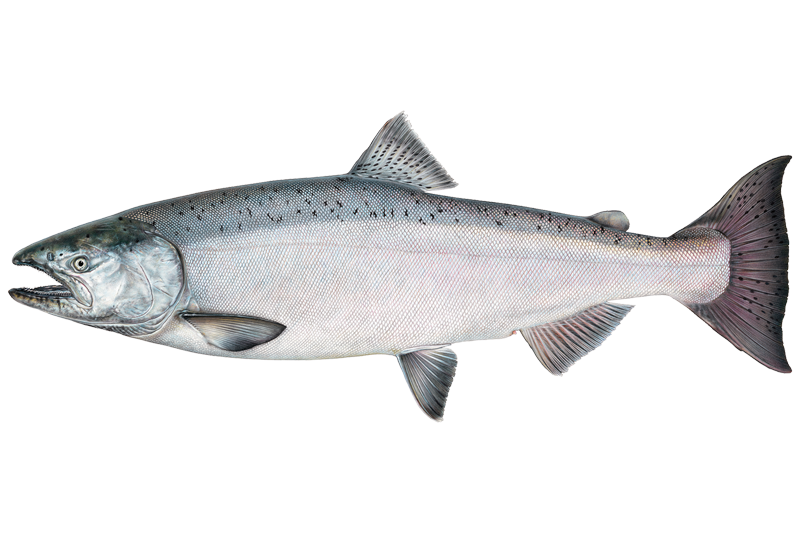
Chinook salmon — king salmon — are introduced to Patagonia but have built a self-sustaining run that moves between the Atlantic Ocean and freshwater rivers in Santa Cruz province.
The Río Caterina, draining into Lago Argentino inside Los Glaciares National Park, hosts the best-documented run in Argentina. Fish regularly exceed 20 kg, and the world all-tackle length record was set here in 2023.
Scientific Name: Oncorhynchus tshawytscha
Also known as King salmon, salmón rey, salmón chinook
- The largest salmonid in Argentina: adults commonly run 10–20 kg, with fish over 40 kg documented in Patagonian waters.
- Silvery flanks in fresh-run fish; as spawning approaches, males darken to olive-brown or deep red with a pronounced hooked jaw (kype).
- Black gum line and black spots on both lobes of the tail — the clearest field mark separating Chinook from other salmon or large trout.
- Thick, deep-bodied build with a large head; noticeably heavier through the shoulder than a brown or rainbow of the same length.
What to know
Habitat Distribution
- Introduced, not native — first stocked in Chile in 1977 and now self-sustaining across Pacific-draining rivers of Patagonia, with Atlantic-running fish established in Santa Cruz province, Argentina.
- Anadromous: adults spend years feeding at sea (or in large lakes) before ascending rivers to spawn; juveniles rear in rivers before migrating out.
- In Argentina, the confirmed freshwater fishery centers on Santa Cruz province rivers — particularly the Río Caterina, Río Santa Cruz, and Río Gallegos — as well as rivers in Chubut and the Río Corcovado drainage.
- The Río Caterina flows through Los Glaciares National Park, draining from Laguna Pearson into Lago Argentino; its glacial-tinted water runs deep in pools and shallow over fast gravel runs.
Key Locations
- Río Caterina, Santa Cruz — the best-documented Chinook run in Argentina, inside Los Glaciares National Park; exclusive access, catch-and-release only.
- Lago Argentino shoreline — lakeshore spoon fishing for Chinook is productive in January and February before fish concentrate in the river.
- Río Santa Cruz, Santa Cruz province — a major drainage with documented Chinook runs.
- Río Gallegos, Santa Cruz province — another confirmed Chinook river in the far south.
- Río Corcovado, Chubut — part of the Pacific-draining Chubut river system where Chinook have established self-sustaining populations.
Specific Spots
- Deep glacial pools hold resting fish during the run — these are the primary holding lies, especially in January and February when fish are fresh from the lake.
- Shallow, fast-running sections let you sight-fish to visible salmon; later in the season (March onward) fish stack in these areas and compete for territory, making them easier to locate.
- The upper three miles of the Río Caterina and the shoreline of Lago Argentino itself — spoons worked along the lakeshore account for fish when river conditions are tough.
- Mammoth Bay on Lago Argentino: fish can be spotted from high rocky banks above the water, allowing sight-casting to cruising salmon.
Chinook Salmon FAQ
Answers from onWater's species guide.
What are the best lures and bait for Chinook Salmon?
Heavy spoons (30–50 g) in silver, gold, or chartreuse are the go-to from the lakeshore and in wide river sections, cast across current and retrieve steadily or with a slow flutter on the drop.
What flies work for Chinook Salmon?
Large articulated streamers, Intruder-style patterns, Bunny Leeches, and Marabou Spey flies, are the primary flies; these imitate a large baitfish or prey item and are designed to be swung on a tight line through holding water, a technique called the swing where the fly arcs across the current at the end of a...
When is the best time to fish for Chinook Salmon?
Late December through mid-April is the run window on the Río Caterina; fish are present from the moment the run begins. January and February: fresh-run fish in deep pools; fly fishing is slower but fish are large and in prime condition. Lakeshore spinning is most productive in this window.
How do you catch Chinook Salmon?
On the Río Caterina, fishing is entirely on foot, wading and working from shore, with guides leading anglers to pools and sight-fishing opportunities.
What do Chinook Salmon eat?
In the ocean and large lakes, Chinook feed heavily on baitfish and crustaceans, building the body mass that makes them so large by the time they enter rivers.
See it in the app
Most maps show you water.
onWater shows you Chinook Salmon.



- 01 · Species map filter
Map every Chinook Salmon water
Pick Chinook Salmon and the map zeroes in on the waters they call home. No more guessing which lake holds them.
- 02 · Waterbody species
Tap any water. See what lives there.
Species, behavior and seasonal patterns for every lake, river and pond, before you leave the driveway.
- 03 · Angler Intelligence
Ask how to catch Chinook Salmon
Tactics, gear and timing from onWater's AI fishing guide, tuned to the species and the water you're on.
Stop guessing where Chinook Salmon are.
Open the map, filter by Chinook Salmon, and head to water that holds them. Download onWater and plan your next trip in minutes.
- Species map filter
- Angler Intelligence
- Fishing journal
Explore other species
Trout, bass, salmon, panfish and everything in between. Each guide unpacks the behavior, seasons, and tactics that put fish in the net.
No species information available.

Smarter Fishing Starts in the App.
onWater Fish gives you everything you need to plan smarter, fish better, and own every trip from first cast to last.