Brook Trout
Brook trout aren't native to Argentina — they arrived in the early 1900s as part of a government-led salmonid stocking program — but Patagonia has done something remarkable with them.
In the cold, clear streams and lakes of Chubut, Santa Cruz, and Tierra del Fuego provinces, brookies grow to sizes that dwarf anything their native North American range produces. This is a specialist's fishery: remote, lightly pressured, and genuinely wild.
Scientific Name: Salvelinus fontinalis
Also known as Trucha de arroyo, salvelino, brook char
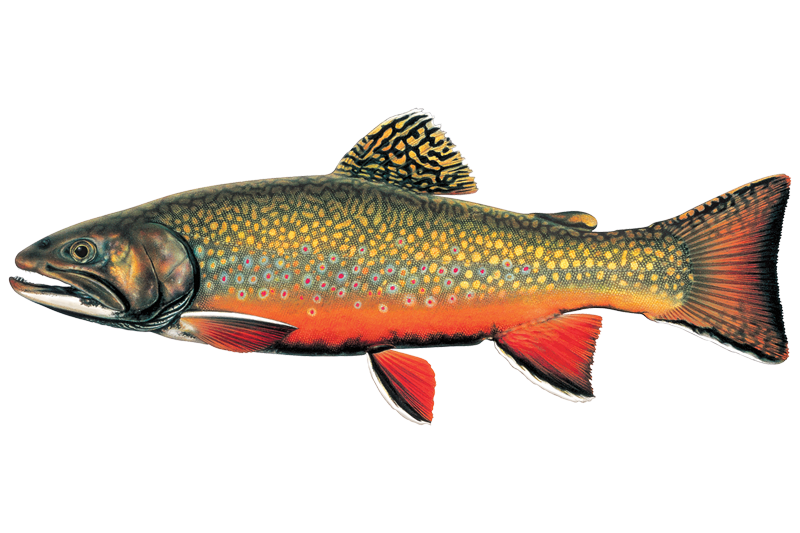
- Olive-green back with pale worm-like markings (vermiculations); sides carry yellow spots and distinctive blue-haloed red spots — no other Patagonian trout has this pattern.
- Lower fins are orange to red with a crisp white leading edge followed by a black stripe — the clearest field mark when a fish is in hand.
- Typical Patagonian fish run 35–55 cm; the remote lakes of Chubut and Santa Cruz have produced specimens pushing 4–6 kg, well beyond the North American norm.
- Spawning males develop a vivid orange-red flush along the belly and flanks — easy to distinguish from brown and rainbow trout sharing the same water.
What to know
Habitat Distribution
- Introduced, not native; stocking efforts between roughly 1904 and the 1930s established self-sustaining populations across Argentine Patagonia.
- Core range sits in Chubut, Santa Cruz, and Tierra del Fuego provinces, with notable concentrations around the Esquel area and the Río Corcovado and Río Pico drainages.
- Prefers cold, clear, well-oxygenated spring creeks, small rivers, and mountain lakes — water that stays consistently cold through the southern summer.
- Also present in the Río Rivadavia system and the spring-creek networks of southern Patagonia near El Calafate, where private estancias hold lightly fished water.
Key Locations
- Esquel area, Chubut province — the heart of the big-brookie fishery; remote lakes and streams here hold some of the largest specimens on record.
- Río Corcovado and Río Pico drainages, Chubut — classic brook trout water with both river and lake fishing in a remote, lightly pressured setting.
- Santa Cruz and Tierra del Fuego provinces — cold, southern latitudes suit brookies well; fish here are wild and largely unfished.
- Estancia Río Pelke area, south of El Calafate — private spring-creek network holding wild brown and brook trout on lightly fished estancia water.
- Río Rivadavia system — holds brook trout alongside rainbows, browns, and landlocked salmon.
Specific Spots
- Deep pools below riffles and runs — brookies hold in the slower water but slide up to the current seam to intercept drifting food.
- Undercut banks, submerged root wads, and large rock ledges provide escape cover; fish tight to these edges, especially during bright midday light.
- Spring creek inflows and groundwater seeps stay cooler than the main river in summer — brookies concentrate here when water temperatures climb.
- In lakes, focus on shallow gravel shoals and inlet streams, particularly as water cools toward autumn when fish stage for spawning.
Brook Trout FAQ
Answers from onWater's species guide.
What are the best lures and bait for Brook Trout?
Small gold or silver inline spinners (sizes 0–2) and spoons are the most consistent conventional producers, the flash and vibration trigger strikes in clear water. Small crankbaits and minnow-style lures in natural colors work well in lakes and the deeper pools of larger rivers where brookies are chasing small fish.
What flies work for Brook Trout?
Dry flies are the method of choice on Patagonia's clear spring creeks, Elk Hair Caddis (imitates an adult caddisfly), Parachute Adams (general mayfly adult imitation), and foam beetle or ant patterns for terrestrials all produce well when fish are rising.
When is the best time to fish for Brook Trout?
Summer (December–February), peak dry-fly season; warm days bring hatches and surface feeding, though midday heat pushes fish to shaded cover and cooler spring inflows.
How do you catch Brook Trout?
Most anglers pursue brook trout in Patagonia by wade fishing small rivers and spring creeks, working upstream and presenting dry flies or nymphs to visible, rising fish.
What do Brook Trout eat?
Aquatic insects form the backbone of the diet, mayflies, caddisflies, and stoneflies in their nymph and adult stages. Match the hatch with a Pheasant Tail or Hare's Ear nymph (both imitate mayfly nymphs) or an Elk Hair Caddis dry (imitates an adult caddisfly on the surface).
See it in the app
Most maps show you water.
onWater shows you Brook Trout.



- 01 · Species map filter
Map every Brook Trout water
Pick Brook Trout and the map zeroes in on the waters they call home. No more guessing which lake holds them.
- 02 · Waterbody species
Tap any water. See what lives there.
Species, behavior and seasonal patterns for every lake, river and pond, before you leave the driveway.
- 03 · Angler Intelligence
Ask how to catch Brook Trout
Tactics, gear and timing from onWater's AI fishing guide, tuned to the species and the water you're on.
Stop guessing where Brook Trout are.
Open the map, filter by Brook Trout, and head to water that holds them. Download onWater and plan your next trip in minutes.
- Species map filter
- Angler Intelligence
- Fishing journal
Explore other species
Trout, bass, salmon, panfish and everything in between. Each guide unpacks the behavior, seasons, and tactics that put fish in the net.
No species information available.

Smarter Fishing Starts in the App.
onWater Fish gives you everything you need to plan smarter, fish better, and own every trip from first cast to last.